Whose Jobs Will AI Take?

As AI seeps a little more into our lives every day, this has become one of the questions on people's minds most.

I'd like to begin with the first line of the first “Lord of the Rings” film: “The world has changed.” How much more will it change? Will utopias come true, or are we heading toward a dystopian future?
As an AI and, especially, a futurism enthusiast, I always argue that medium- and long-term developments are largely “UNPREDICTABLE.” Because people mostly try to read the future through the current status of technology. What do I mean?

Look at the sci-fi series and films shot in the 1970s and 80s. You'll watch many of them with a smile. Apart from one or two shared predictions, they all modeled the change in technology, its manner of use and its effect on life incorrectly. Because they took where industry and technology stood at the time as their basis and built their predictions on that. But things didn't turn out that way at all. I say this while setting Isaac Asimov and Jules Verne as authors, and Minority Report as a film, apart.

So, when trying to understand what the future holds, I think modeling it with a “what did we think in the past versus what actually happened” perspective — while not guaranteed — gives more accurate results than modeling from the current status. A bit tangled? Then let's illustrate with a utopian scenario:

One of the most popular topics of the past decade is autonomous driving and transport, and how these will evolve over time. Why? Because today the automotive sector is one of the areas where technology finds the most room. It's a century-old giant; transport and logistics are intertwined with life and many other sectors. Naturally, we too read the future through the status we're used to. Now let's take flight: imagine that, with AI and quantum computing power, scientists make advances in quantum physics and, “put simply,” make “teleportation” possible. How would that affect the automotive and logistics sectors, life, habits and professions?
The first two words of the title are “Artificial Intelligence.” Actually I argue that the change won't come from AI alone and that the accurate term is “Technology” — but I won't change the title.
Was that example too futuristic? I recommend watching Netflix's “3 Body Problem”; the part where two scientists show, in a holographic universe, how dramatically each stage of humanity's learning and progress shortens…

Since the first two words of the title are “Artificial Intelligence,” let's understand how development in this field accelerates on a logarithmic curve, and generalize that curve to all technological progress. That way we can grasp the dizzying pace not just of AI but of every field of technology.
AI's journey so far

The person who named the concept of artificial intelligence is John McCarthy; he first used the term in 1955. (Although Alan Turing had earlier put forward the famous “Turing Test,” we first heard the words “Artificial Intelligence” from McCarthy.)
Contrary to belief, beyond just text output or prediction models, scientists began working on machines' ability to “see” a very long time ago. Because AI was always imagined as machines that would have human abilities, and more than half of the cortex in the human brain processed visual information. So the first “computer vision” doctoral thesis was written in 1963.
Of course the hardware of the day was quite limited for training and running these models. So in the roughly 20-year period between 1970 and 1990, the work stayed mostly theoretical. This period is called the “AI winter.”
During the First Gulf War, AI was tried in planning the US military's logistical movements and was seen to provide a 20-fold increase in speed and efficiency. On that, the US turned its attention back to the field. With hardware and cloud technologies developing too, AI began finding more support and funding.
There's no need to recount what came next at length, I think. Recommendation systems, spam filters, face recognition, object detection, then large language models, and even “will it gain consciousness in the near future?” questions — all show us that the pace of progress keeps accelerating.
Progress from the 2000s to today is tens of thousands of times greater than progress from 1955 to the early 2000s. If the next 20-30 years are tens of thousands of times this period again…
So what will happen? Who will be affected?

Peter Drucker has a line I love: “The best way to predict the future is to design it.” Right now there's a mindset that places AI at the center of designing the future too. And this will, of course, cause major professional transformations; it's not hard to see there will be disruptive effects. In some professions we'll see the effects of AI use more — in fact we've already begun to.

Even the change in some concepts used within computer science alone is an indicator. For example, what we used to call “data mining” is now “data science”; what we defined with the classic word “reporting” has been replaced by “data analytics.”
Or, going further back: with the use of automobiles, the farrier's trade was buried in history. But now there are far more tire repairers. In every field where there's R&D and progress, professions, habits and much more have changed and transformed over time.
It would be wrong to believe technology alone will put people out of work. To understand this better, let's ask: “When the world's population was 5 billion, what was the unemployment rate; when it became 8 billion, did the rate rise with the effect of technological progress too?” (Of course you'd need to filter out various political and economic effects in that change.)
The answer matters because it helps us see that those who transform their ways of working and their habits will be more productive in other job functions. The key issue is whether people — and even companies and universities — can keep pace with this change.
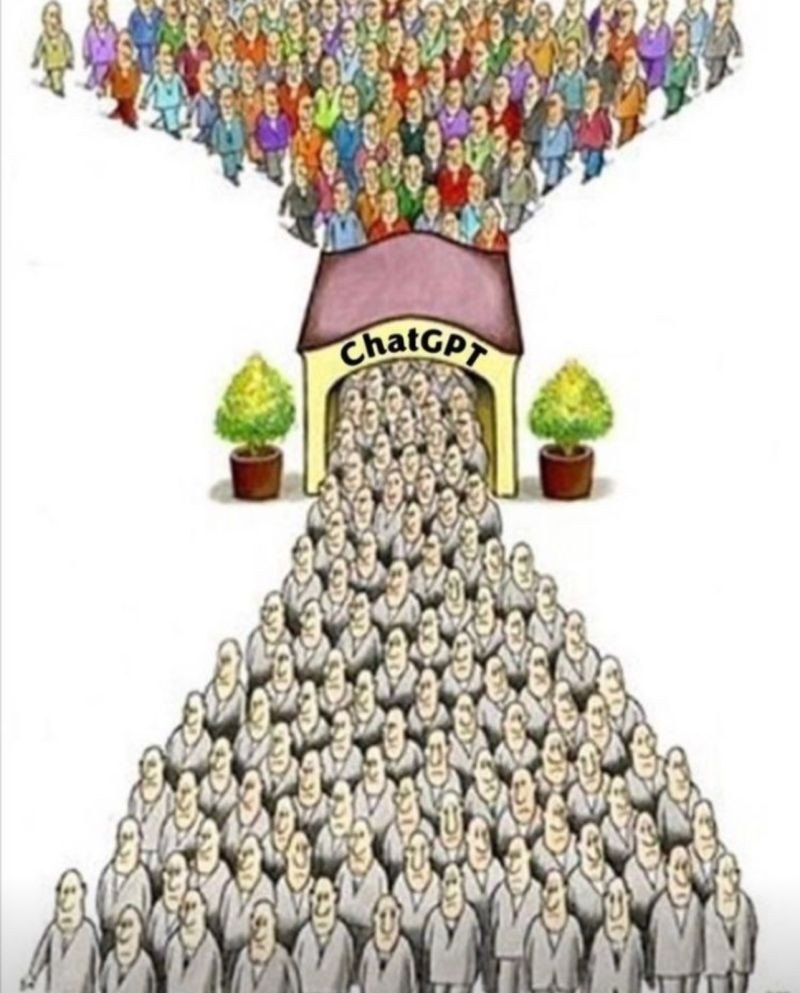
I think people misunderstand the now-clichéd line “Whoever can't adapt to this era will be out of work.” Adapting to this era is not asking ChatGPT a question in a browser and using its answer as is! So what is it, then?
- Giving yourself new skills.
- Not using new tools amateurishly, but thinking about how to bring them more professionally into your own workflows.
- And even starting new ventures.
- Never forgetting that at the center of change is the “human.”
Individual effort alone is, of course, not always enough to keep pace with this change. Universities need to integrate this topic more into the curricula of every professional branch. It's not enough for companies to tell employees to “use AI more”; they must support their development with training to make them better equipped.
This transformation is only possible with a wholesale mindset.
When this change is handled correctly at both the individual and institutional levels, you don't need to fear technology for your professional life. As long as, when automobiles started being sold, you're not stubbornly saying “I'll keep nailing shoes onto horses' feet”…
← All posts